Skip to product information
1 of 1
Pierre CHARRON

Treatise on Wisdom

Leads At the Elseviers' 1646

Reference: 40999

The work was published in 1646 by Bonaventure and Abraham Elsevier, brothers and partners who printed in Leiden from 1626 to 1652. This illustrious family of Dutch typographers and printers invented the typeface that bears their name. The Elzevir family printed nearly 2000 volumes between 1583 and 1712, the year the last survivor died. One of the typographic marks of the Elzevirs, created by Issac Elsevier in 1620, adorns the great hall of the Library of Congress in Washington D.C.

Pierre Charron (1541-1603) was a theologian, philosopher and moralist. After studying law, he was ordained and quickly made a name for himself through his preaching, becoming the preacher of Marguerite de France. He became friends with Michel de Montaigne. In 1595, he was sent to Paris as a deputy and became president of this assembly. His Traité de la sagesse published in 1601 in Bordeaux, represents his major work and caused a scandal. In it, he defended religious tolerance and was accused of atheism. The work is dedicated to Prince Maximilian of Burgundy. This 1646 edition is considered by Brunet to be the most elegant of the 4 editions published by the Elzevirs (Brunet, Manuel du libraire, Vol. I).

Paul Fréart de Chantelou was the first Frenchman to discover Nicolas Poussin, a 17th-century French painter. Sent to Rome to bring Nicolas Poussin back to France, he took care of the artist during the 2 years of his Parisian stay between 1640 and 1642. Then, after Poussin's return to Rome, Paul Fréart de Chantelou maintained a rich correspondence with the painter, an important source of information on the last 20 years of the painter's life.

  • Member of the SLAM
  • Careful packaging
  • Secure Payment

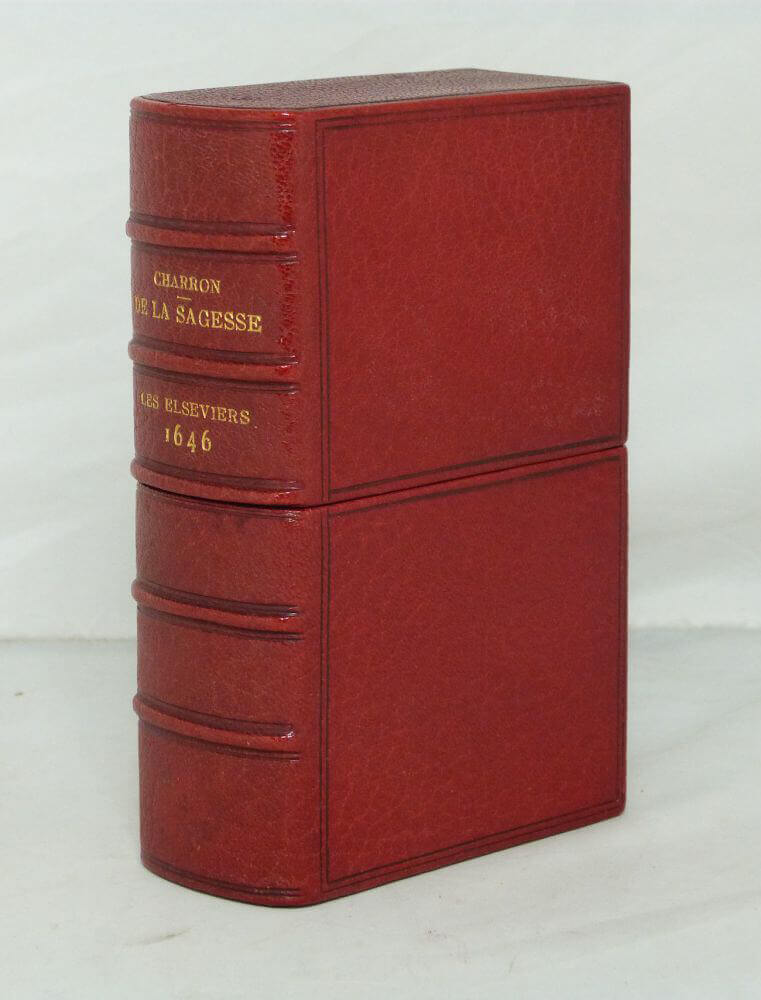
Binding in full red morocco with gold initials FDC. Ribbed spine. All edges gilt. Very beautiful unsigned contemporary binding. However, its exceptional quality suggests attribution to LE GASCON (15..-1653), universally admired during his lifetime for the quality of his binding and gilding work. The FDC initials are those of Paul Fréart de Chantelou, a military engineer and patron of artists of his time, particularly Nicolas Poussin. The work is presented in a remarkable book-box made by the English bindery Rivière and Son, founded by Robert Rivière in association with his grandson Percival Calkin in 1881. This workshop developed magnificent bindings with original approaches, prioritizing high-quality leathers. The book-box is a perfect example, both in the quality of the leather used and in the care taken in fitting the two parts, which required the creation of air escape holes to ensure proper closure. The workshop closed in 1939.

  • - Number of volumes: 1 volume
  • - Format: Duodecimo
  • - Binding: Bound
  • - Collation: 361 pp
Request photos
View full details

FAQ

Pourquoi acheter un livre à la Librairie KOEGUI ?

Depuis 2011, la Librairie KOEGUI accompagne bibliophiles, collectionneurs et passionnés avec une promesse tenue : expertise sérieuse, description honnête, et confidentialité absolue de vos achats. Membres actifs du SLAM et de la LILA, nous respectons les standards déontologiques les plus exigeants de la profession — de la première question à la réception de l'ouvrage.

Proposez-vous un échelonnement du règlement pour les pièces de valeur importante ?

Comment l'emballage des livres est-il géré ?

Les livres anciens et rares méritent qu’on les traite avec le même soin qui a présidé à leur conservation ! Papier bulle et cartonnage adapté à ses dimensions, chaque ouvrage est soigneusement protégé pour une expédition en toute sécurité.

J’aimerais offrir un livre ancien mais je n’y connais pas grand chose - que faire ?